
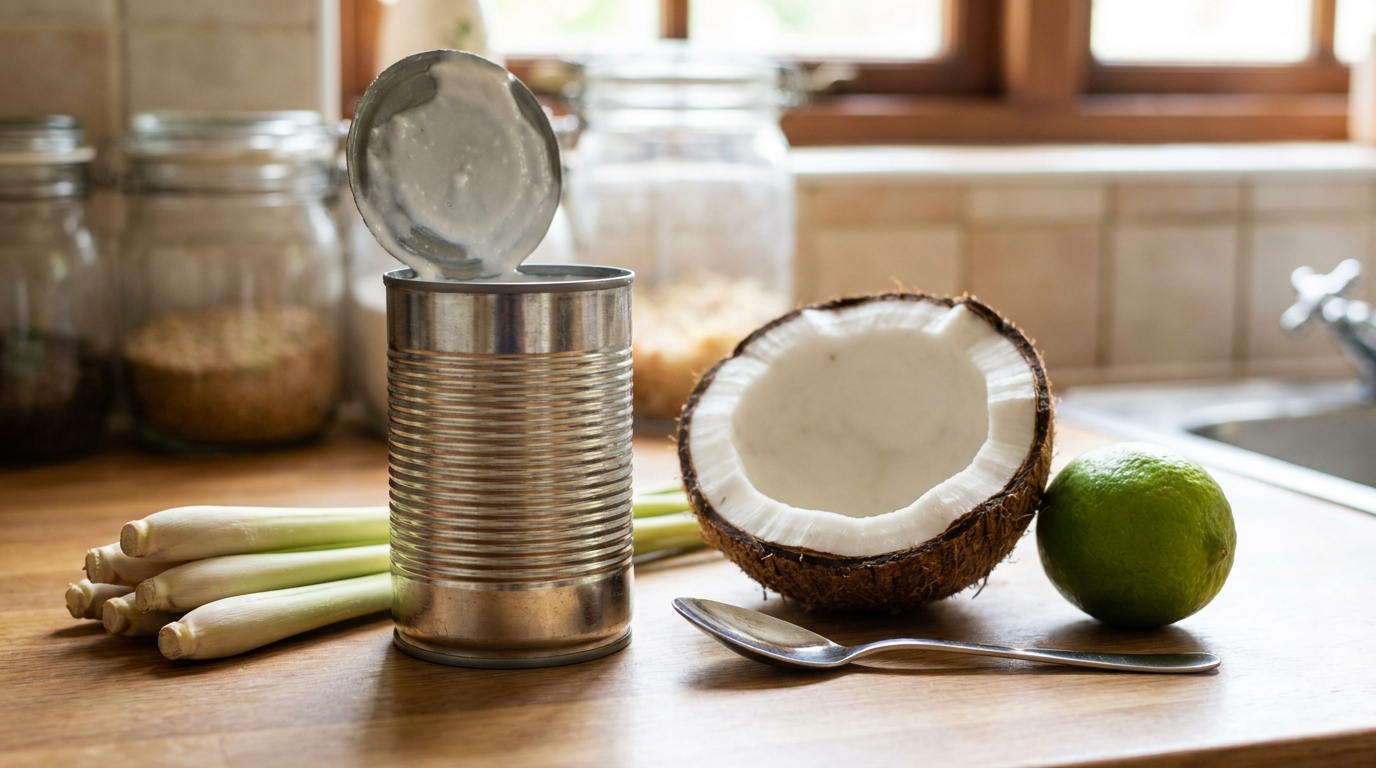
Coconut milk is the creamy base of Asian cooking and one of the most versatile store-cupboard products there is. It is made from peeled and grated white coconut flesh and water, pressed several times, which makes it something entirely different from coconut water, the clear liquid inside the nut. Fat content decides taste and consistency: it ranges from a light 5 per cent to a full-bodied 22 per cent. As a Hamburg food importer, I. Schroeder KG carries coconut milk in all the usual versions, from the classic tin through to the organic product.
How is coconut milk actually made?
Despite what the name suggests, you cannot tap coconut milk from the nut. First the brown “nut” is knocked out of the green, fibrous husk of the coconut fruit. The white flesh of ripe coconuts is then broken out of the brown shell, peeled to remove the brown skin, and after that chopped, grated, mixed with hot water and finally pressed several times. The result is a thick, aromatic milk whose fat content can be steered through the ratio of flesh to water. The first pressing produces a particularly rich coconut milk, while further pressings yield lighter qualities.
A look at the ingredients list is worthwhile: good coconut milk consists essentially of coconut extract and water. It is naturally lactose free and vegan, which makes it a fixture in plant-based cooking as well, from curry through porridge to cake.
What does the fat content mean in coconut milk?
Fat content is the most important quality characteristic and at the same time the criterion for use. It reflects the amount of extracted coconut flesh. The range at I. Schroeder KG offers coconut milk in these grades:
- Classic (17 to 19 per cent or 20 to 22 per cent fat): the standard quality in the 425 ml tin, available in organic quality on request. It delivers the typical creaminess for curries, soups and sauces.
- Light (5 to 7 per cent or 12 to 14 per cent fat): also in the 425 ml tin. Considerably fewer calories and a more liquid consistency. Well suited to light soups, smoothies and dressings.
- Combibloc or Tetra Pak (at least 17 per cent fat): from the small 200 ml carton for single households through to the practical 1 litre carton for bulk buyers, food service and anyone who cooks with coconut milk more often.
A simple rule of thumb: the higher the fat content, the creamier the result and the more intense the coconut aroma. If you want to thicken a sauce, reach for the classic version. If you are only after a fine coconut note, the light version will serve you well.
How do coconut milk and coconut water differ?
The two products are often confused but have little in common. Coconut water is the clear, slightly sweet liquid that occurs naturally in young, green coconuts. It contains virtually no fat but does provide minerals such as potassium, and it is drunk well chilled as a refreshment, on its own or in a smoothie. I. Schroeder KG carries coconut water in the 330 ml Combibloc or Tetra Pak.
Coconut milk, by contrast, is pressed from the chopped flesh, rich in fat and intended for cooking. Put briefly: you drink coconut water and you cook with coconut milk. Substituting one for the other in a recipe risks an unwanted result.
Which coconut milk suits which dish?
A Thai curry depends on the full creaminess of a classic coconut milk with 20 to 22 per cent fat. The fat phase carries the aromas of curry paste, lemongrass and galangal and gives the sauce body. Desserts such as coconut rice pudding or a coconut panna cotta also work best with the rich version.
For a light vegetable soup, a salad dressing or a morning smoothie, the light version is entirely sufficient. It brings the aroma without making the dish heavy. In commercial kitchens and food service the 1 litre Combibloc has proved its worth: once opened, it can be dosed cleanly and stored without taking up much space.
A practical note on storage: unopened coconut milk in a tin or Combibloc keeps for a long time and therefore belongs in any well-stocked store cupboard, just like other preserves. Opened coconut milk should be transferred to a non-metallic container, covered and kept in the fridge, and used within a few days. The fact that the milk in the tin separates into a firm cream layer and liquid is not a defect: simply stir it vigorously or shake the tin well before opening.
Where does the coconut milk from I. Schroeder KG come from?
Coconut palms grow in the tropical climate of South East Asia. The Asian range at I. Schroeder KG comes from countries of origin such as Thailand, Sri Lanka, Vietnam, Indonesia and the Philippines. Since 1953 our Hamburg trading house has sourced food from around the world, checking suppliers and goods against recognised standards. There is more on this on the certifications page. Alongside coconut milk and coconut water, the range of more than 600 articles also includes bamboo shoots, soy sauce and kimchi.
Frequently asked questions
Is coconut milk vegan and lactose free?
Yes. Coconut milk is made exclusively from coconut flesh and water and contains no dairy components at all. It is therefore naturally lactose free and suitable for vegan cooking. That makes it a popular substitute for cream in soups and sauces.
Which fat content is best for curry?
For a classic curry, coconut milk with 17 to 22 per cent fat is the one to choose. It gives the sauce body and carries the spice aromas. Light versions are better suited to light soups and drinks, since they stay more liquid.
How long does opened coconut milk keep?
Opened coconut milk should be transferred to a non-metallic container, covered and kept in the fridge, and used within a few days. Leftovers freeze well in portions, in ice cube trays for the next sauce for example.
Why has the coconut milk in my tin gone solid?
When stored cool, coconut milk separates into a firm fat layer and watery liquid. This is a natural process and not a quality defect. Simply stir the milk or warm it gently and the two will combine again.
Can I use coconut water instead of coconut milk?
No, the products are not interchangeable. Coconut water is a clear, almost fat-free liquid for drinking, while coconut milk is a creamy cooking ingredient made from the flesh. A curry made with coconut water would stay thin and would not reach the typical creaminess.

